Internal Links
Internal links your site is missing, with the anchor text to use.
In appWorkspacesLinks
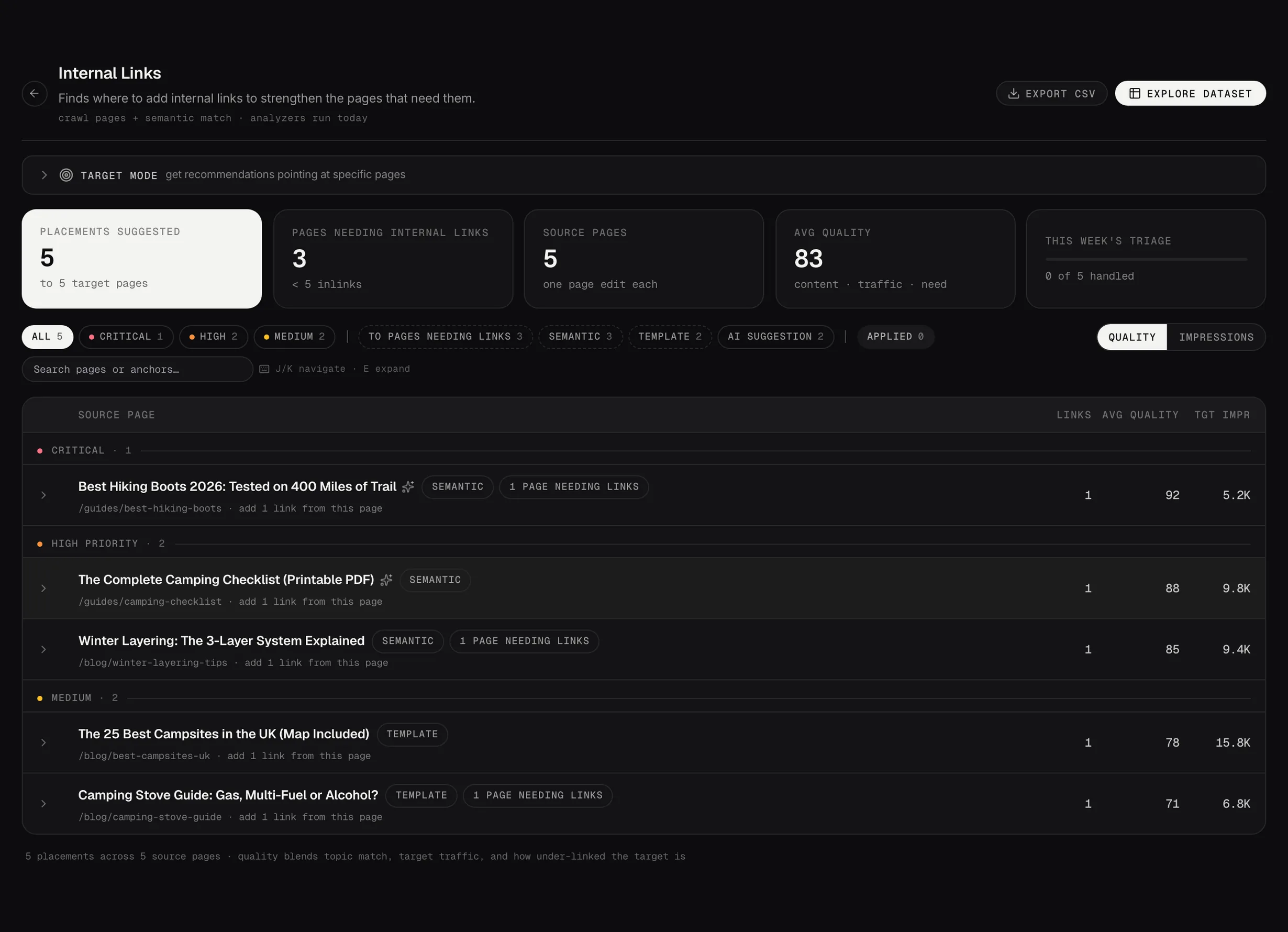
Internal Links: placements suggested for the pages that need links most.
Demo dataWhat the list shows
Pages that should link to each other and don't. Each finding names the page to link from, the page to link to, and suggested anchor text.
Start with the links pointing at pages you care about commercially. An internal link is one of the few things on this list you can act on in a minute.
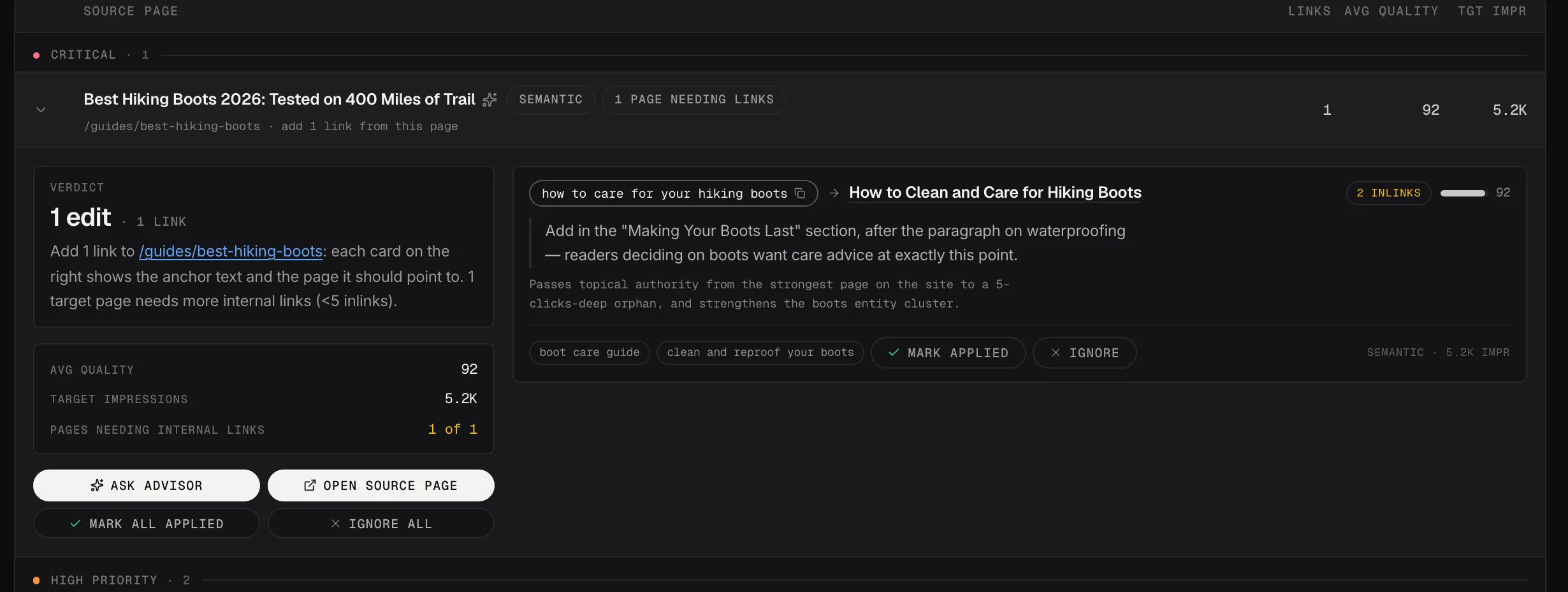
One placement: the source page, the anchor and where the link goes.
Demo dataWhy some suggestions are stronger than others
A suggestion is worth more when the linking page is already strong and the target page is weak, because that's where the link changes something. Suggestions between two weak pages are listed lower for that reason.
The anchor text is a suggestion rather than an instruction. Use the wording that reads naturally in the sentence you put it in.
Target mode: links pointing where you choose
The normal list is whatever the analysis thinks is worth linking. Target mode turns that around: paste in the pages you want links to, up to fifty full URLs one per line, and it runs a links-only analysis where every suggestion points at one of them.
This is the one to use when you've just published something, or when a commercially important page isn't getting the internal support it should. Rather than hunting the list for suggestions that happen to point at it, you ask for them.
One thing to know before you run it: a targeted run replaces your current link recommendations until the next full analysis. So finish anything you were partway through first.
What to do with it
Add the link. Then Ask Advisor if you want a fix plan across a group of pages rather than one at a time: the Strategist takes the suggested anchors and comes back with an order to work in.
Working a finding
Open any finding and you can take it somewhere else without retyping it. Ask Advisor opens the Strategic Advisor with that finding and its full context already loaded, so you can ask why it matters or what to do first and get an answer using your own numbers. Create brief (or Rebuild in Studio) opens a Content Studio session for the page, pre-filled the same way.
Both carry the finding with them. You're not starting a conversation or a brief from nothing, which is the whole point of launching them from here rather than opening the Strategic Advisor or Content Studio cold.
Most findings also carry an AI Playbook: a written recommendation for that specific page. Some are generated automatically after a run, the rest are generated when you ask. You can also tick several rows and generate advice for all of them in one go, with the cost shown before anything runs. How many are written automatically is the Auto-generate for top setting in that analyzer's Configure panel, and zero means they're only written on request.
Mark applied does more than tick it off. The page joins Impact Tracking in Command Center, which then follows its clicks, impressions and position from that date onward, so you can see what happened after the change.
Getting rid of one you don't want
Ignore on any finding hides it. It leaves the queue and moves to the Ignored pill in the filter rail, where Restore puts it back, so nothing is destroyed. The Ignored pill only appears once you've ignored something.
Ignoring handles one finding. If the same pages keep coming back, add them to Excluded pages in Settings, under Data Pipeline: find Links in the analyzer list and click Configure. One pattern per line, * as a wildcard, and plain text matches anywhere in the URL. Matching pages stop becoming findings from the next run.
That's the difference worth knowing: ignoring hides one finding, excluding a page stops future findings for it. Tag pages, author archives and paginated listings are the usual candidates.