See what AI assistants say when people ask about your brand and market.
Searchscope asks the questions your buyers ask across six AI assistants, every week, and keeps every answer word for word. You see where you were recommended, where a competitor was recommended instead, and which sources each assistant cited in its answer.
-
ChatGPT
named you in 18 of 48 answers, cited you in 8 38% -
Perplexity
named you in 22 of 48 answers, cited you in 16 46% -
Claude
named you in 10 of 48 answers, cited you in 2 21% -
Google AI Overviews
no mention on 24 answers this run 0% -
Gemini
named you in 14 of 48 answers, cited you in 4 29%
Mention rate, this run5 of 6
Six assistants, the same questions, every week.
A one-off check tells you where you stood on a single day. Answers move as assistants update, as competitors publish and as the sources they cite change. Searchscope runs the same set of questions on a weekly schedule, so you’re reading a trend rather than a snapshot.
-
 ChatGPT
-
 Claude
-
 Gemini
-
 Perplexity
-
 Google AI Overviews
- Google AI Mode
- The same questions to each oneEach assistant gets the same set of questions, which makes it easier to compare how your brand appears across them.
- Run twice to capture variationChatGPT, Claude, Gemini and Perplexity can return different answers to the same question, so Searchscope asks each question twice and keeps both responses. Google AI Overviews and AI Mode are read once, because they return a result page rather than a fresh answer.
- History stays intact as assistants changeAdding or retiring an assistant doesn’t alter previous runs. A new one starts appearing from its first run, and a retired one keeps the runs it already took part in.
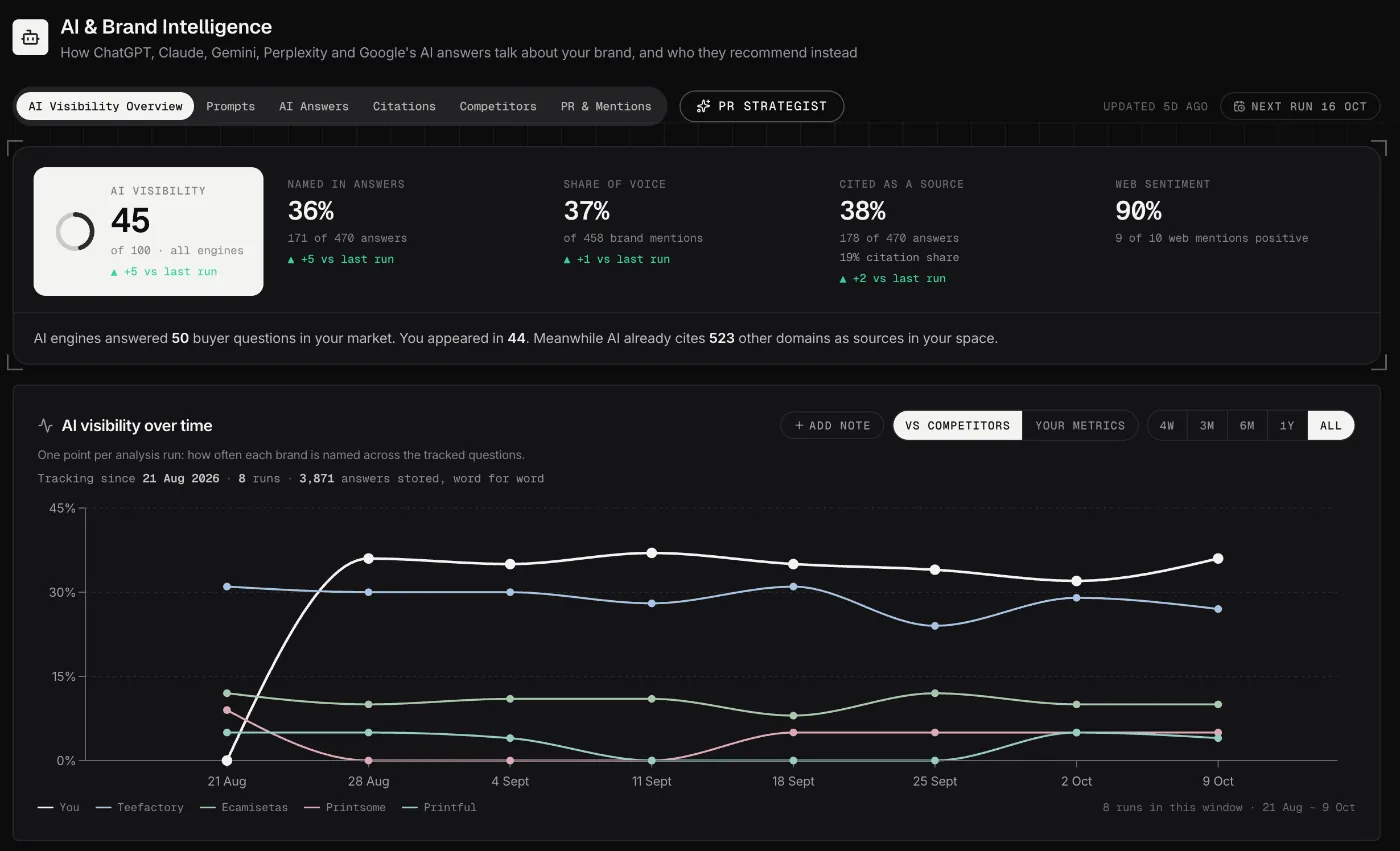
AI visibility on a live account: how often six AI engines name the brand, run by run, against four rivals.
Live accountAsking about you isn’t the same as asking about the problem you solve.
Those two questions measure different things, so Searchscope keeps them in separate libraries and reports them separately.
- Brand questions Questions that name you. These measure branded recall: when your brand is named directly, does the assistant identify and describe it accurately? Useful, but it’s the easiest test to pass.
- Non-brand questions Questions that name nobody, of the “best tool for” kind your buyers actually type. These show whether your brand is recommended on relevant category questions when the prompt doesn’t mention you.
- Product questions Questions about one product line, tracked as their own library so a strong line doesn’t hide a weak one behind an average.
Group your questions the way you sell.
Put your questions into groups of your own naming, by product line, service or market, and assign them in bulk rather than one at a time. Every view respects the grouping, so you can read the overview, the answers and the citations for one part of the business on its own.
- An average hides the thing you needed to seeA brand doing well across most of its range can be losing badly in one line. Grouped, that shows up as its own row instead of disappearing into a single number.
- Get alerts for the groups that matterTurn alerts on for a group and Searchscope emails you when it drops sharply between runs, so you don’t have to keep checking the ones that are steady.
- Small groups don’t trigger false alarmsA group needs at least three questions in both runs before it can trigger an alert, which reduces the chance that a small number of changing answers creates a false alarm.
Suggested questions arrive with their reason attached.
Searchscope proposes questions to track and labels each one with where it came from, so you can judge whether it belongs in your set before you add it.
- Already cited you
- You rank for it
- Competitor gap
- Generated
The answers, word for word.
Searchscope keeps the full text of every answer, not a summary of it. For each one you can see which brands were named, how early yours appeared, and whether the assistant linked to you or to somebody else.
“For a small agency, most people land on one of three. Competitor A is the usual recommendation for its reporting, Competitor B is cheaper per project, and your brand is worth a look if you want the analysis rather than just the numbers…”
- NamedCompetitor A, Competitor B, you
- Your first mentionthird of three
- Linked to youno
- Sources usedg2.com, reddit.com, competitor-a.com
Who gets cited instead of you.
Every domain cited in an answer is collected across your runs, so you can see which sources appear most often in your category. Domains that already cite you are listed apart from the ones that don’t yet, because those are two different jobs.
- How often it appearsHow many of your tracked questions cite the domain, which separates a source that appears repeatedly from a one-off citation.
- Which assistants cite itA domain cited by four assistants is a different opportunity from one only Perplexity cites.
- Whether it already mentions youEach domain is marked according to whether it currently cites you, cites a competitor you track, or neither.
- How consistently it appearsWhen the domain was first cited and how many runs it has appeared in, which separates a durable source from a one-week result.
- The pages being citedThe specific URLs on that domain that assistants cited, rather than the domain on its own.
- Unrecognized name variantsWhen an answer refers to you by a spelling or variant you haven’t registered, it’s raised for you to accept or dismiss, so those mentions aren’t quietly scored as misses.
One score, and the five things inside it.
The AI visibility score is broken into five components, with the same weighting used across your dashboard, your reports and your history.
- Share of voice35%Your share of the brand mentions across answers, measured against the competitors you track.
- Citation rate20%How often an assistant links to you in the answer, not just names you.
- Branded recall20%On questions that name you, how often the assistant knows who you are.
- Mention rate15%How often you’re named at all.
- Breadth10%How many of the assistants mention you, so strength on one doesn’t read as strength everywhere.
- Branded recall is measured on its ownAnswers to questions that name you are scored separately as recall, so you can see how much of your standing comes from people who were already looking for you.
- No brand questions, no penaltyIf you don’t track brand questions, branded recall is excluded and its weighting is redistributed across the other four components.
Your brand against the brands you’re measured against.
AI visibility shows you the output. Brand Intelligence shows you the wider signals around your brand and your competitors. Compare links and authority, media coverage and branded search alongside your AI visibility, so you can see where competitors are stronger and where the gaps may be.
- Mentions in AI answers, run by runEvery run records how many answers named you, how many cited you, and the same for each competitor, so you can watch a gap widen or close instead of comparing two screenshots.
- Links and authorityReferring domains, total backlinks and domain rank for every brand in the set, side by side.
- Media coverageTotal mentions and news mentions, the domains carrying them, and the split between positive, negative and neutral coverage.
- Branded search demandHow search volume for each brand name changes month by month, as one indicator of brand interest and awareness.
Spot unusual bursts in competitor coverage and links.
Searchscope tracks new and lost referring domains for each brand you benchmark. When activity rises well above that brand’s normal rate, Campaign Radar flags the period for investigation.
- A burst is worth investigatingIt can signal a campaign or a piece of content that earned attention. The monthly view shows you when; investigating it shows you what.
- Find the pages attracting the new linksSearchscope pulls the new links from that window and groups them by the page they point at, which helps identify the content or asset behind the activity.
- Separate earned coverage from boilerplateLinks from privacy, terms and careers pages, and links whose anchor is only “click here” or a bare URL, are counted separately from likely earned coverage, so a burst isn’t inflated by boilerplate.
- A counter angle to considerEach investigation is labeled with the kind of campaign it looks like, alongside a suggested angle of your own.
An advisor focused on brand visibility and PR.
The PR Strategist analyzes your AI visibility, competitor benchmarks, PR activity and citation gaps together, helping you decide what to work on next.
- Why a competitor is recommendedAsk why assistants recommend a competitor over you and get an answer grounded in your own runs, rather than a general theory about how AI search works.
- Which sources are worth approachingTurn the citation gaps into a ranked list of sources: the domains cited most often in your category that don’t mention you yet, and what each one already cites.
- How to respond to competitor activityTake an investigated burst from Campaign Radar into the Strategist and work up your response to it.
- Which signal to focus onYour benchmark shows where you’re behind on links, coverage and branded search. The Strategist helps you pick which one to work on rather than trying to move all three.
It plans and drafts with you. Approaching people, and the relationships that come out of it, stay yours.
What to do with a gap once you can see it.
- Ask the Strategic AdvisorBring a visibility gap into the Strategic Advisor, or the PR Strategist for brand and PR work, to establish why it’s happening and whether it’s worth doing before the rest of your queue. Both work from your AI runs alongside your search performance rather than in isolation.
- Brief it in Content StudioSend a finding to Content Studio with the questions, the answers and the competing sources already attached, so the brief starts from the evidence.
- Track what happened nextMark the work as applied and Impact Tracker records the baseline from that date, so you can see what happens to mentions, citations and visibility afterwards.
Find out what AI assistants say about your brand.
Connect your site and Searchscope tracks the questions that matter in your category across six assistants, week after week, and keeps every answer so you can read what was actually said.