Property 01
Intent
The search intent behind the cluster: commercial, informational or navigational. This helps determine what kind of page should rank for it.
Page-level reporting can miss changes happening across a wider topic. A page may continue to rank while visibility declines across the related queries around it.
Searchscope groups related queries into topic clusters, identifies the page ranking most strongly for each cluster and measures how concentrated the cluster is on that page. It then tracks changes across the cluster, rather than looking at individual URLs in isolation.
Clicks at risk-84in volatile clusters · 7d
Topic clusters381,240 keywords
Fragmented6no anchor page
18 of 38 clusters · clicks at risk = last 7 days vs the 7 before
Searchscope groups related queries into clusters and identifies the search intent behind each one. Each cluster includes the number of queries it contains and the estimated search volume, so movement in something worth twelve thousand searches a month isn’t filed next to movement in something worth thirty.
Property 01
The search intent behind the cluster: commercial, informational or navigational. This helps determine what kind of page should rank for it.
Property 02
How many queries are in the cluster and their estimated monthly search volume, so higher-volume topics rise in the queue.
Property 03
The page currently ranking most strongly across the cluster. It may not be the page you expected, and some clusters have no clear dominant page at all.
Coverage measures how much of a cluster’s impressions one page gets. A clear dominant page is something you can optimize; a cluster split across several pages is harder to move, and often a sign of cannibalization. Coverage is scored on every cluster, so the weak ones surface before they slide rather than after.
Coverage
One page gets at least 70% of the cluster’s impressions. A clear dominant page to optimize.
Coverage
One page leads the cluster, getting 40 to 70% of its impressions, with other pages sharing the rest.
Coverage
Pages rank for the cluster’s keywords, but none stands out as the anchor page.
Coverage
No page recorded impressions for the cluster’s keywords in the last run. An opening rather than a problem.
Coverage
Several pages split the cluster’s impressions with no dominant page. A cannibalization risk worth consolidating into one target page.
Searchscope measures ranking movement across the queries in each cluster rather than relying on a single page or keyword. A volatility threshold filters out normal week-to-week changes, so the queue focuses on more meaningful movement.
Cluster Volatility catches what page-level reporting misses. A dominant page can hold its ranking while visibility declines across other queries in the same topic. Looking at the cluster makes that wider decline visible.
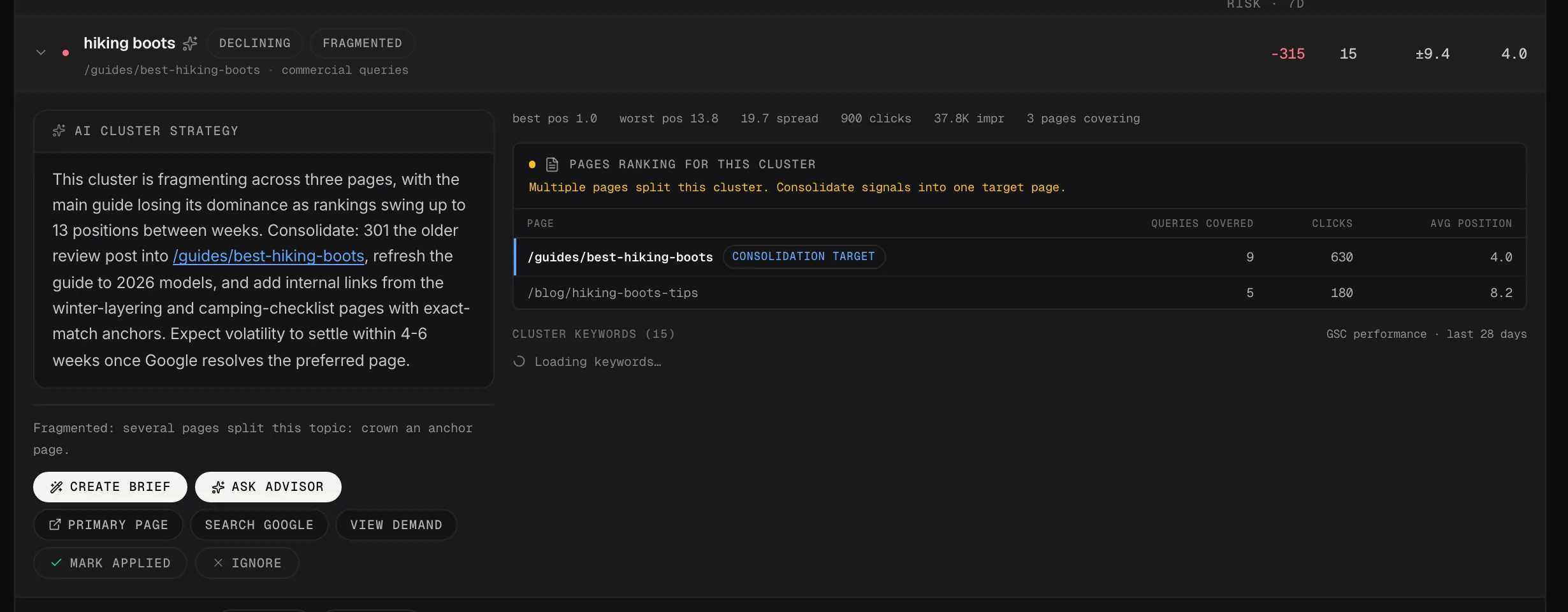
One topic: the pages splitting it, the dominant page and how to consolidate.
Demo dataUse the Strategic Advisor to analyze what changed across the cluster and whether the opportunity should be prioritized against the other work in your queue. Send the finding to Content Studio to create a brief using the queries you currently cover, the gaps within the cluster and the relevant search volume.
Once the work is live, mark the finding as applied. The Impact Tracker records the baseline from that date, so you can see what happens to coverage, rankings and visibility afterwards.
Connect your site and Searchscope runs the analyzers automatically, filtering and prioritizing the findings that deserve your attention.