Rankings have always been a proxy for what SEO actually wants: visibility that turns into useful traffic and, eventually, business.
For a long time the proxy was good enough. Move from position eight to position two and you would normally expect more clicks.
AI Overviews make that relationship much less reliable.
A ranking can stay still while the opportunity changes
You can rank first and still lose a large share of the click if an AI Overview answers the query above you. Nothing has changed in the rank tracker, but the commercial value of that position has.
The opposite can happen as well. A page that doesn’t appear prominently in the traditional results can still be cited inside the generated answer. On a normal rank report it looks invisible. In the answer the user actually sees, it isn’t.
That’s why position on its own is becoming a weaker way to describe visibility.
What we would watch instead
Keep the ranking data, but put it next to the rest of the search result.
Is there an AI Overview? Is your page cited inside it? Is the result still getting clicks? Has the click-through rate changed even though position hasn’t? Those signals tell you whether the ranking is still doing the job you think it is.
The content implication is fairly practical too. Pages need sections that answer the query cleanly enough to be useful outside the page itself. That doesn’t mean writing everything as a series of snippet-sized answers. It means making the useful parts easy to identify, understand and cite.
We’d also treat the appearance of an AI Overview across an important query set as a material search change, even if no ranking moved. If traffic falls after that, the answer isn’t automatically “improve the rank”. You need to understand what took the click.
That matters for reporting too. A monthly deck that celebrates stable positions while clicks and enquiries are falling is giving the team false comfort. The useful report connects position, SERP shape, clicks and citations so you can see whether the visibility still has value.
None of this makes rankings irrelevant. They are still an important signal. They just need more context than they used to.
The operating-system model is useful here because this is a moving picture, not a one-off audit. Brand and AI visibility tracks how your brand appears in AI answers and which sources are being cited.
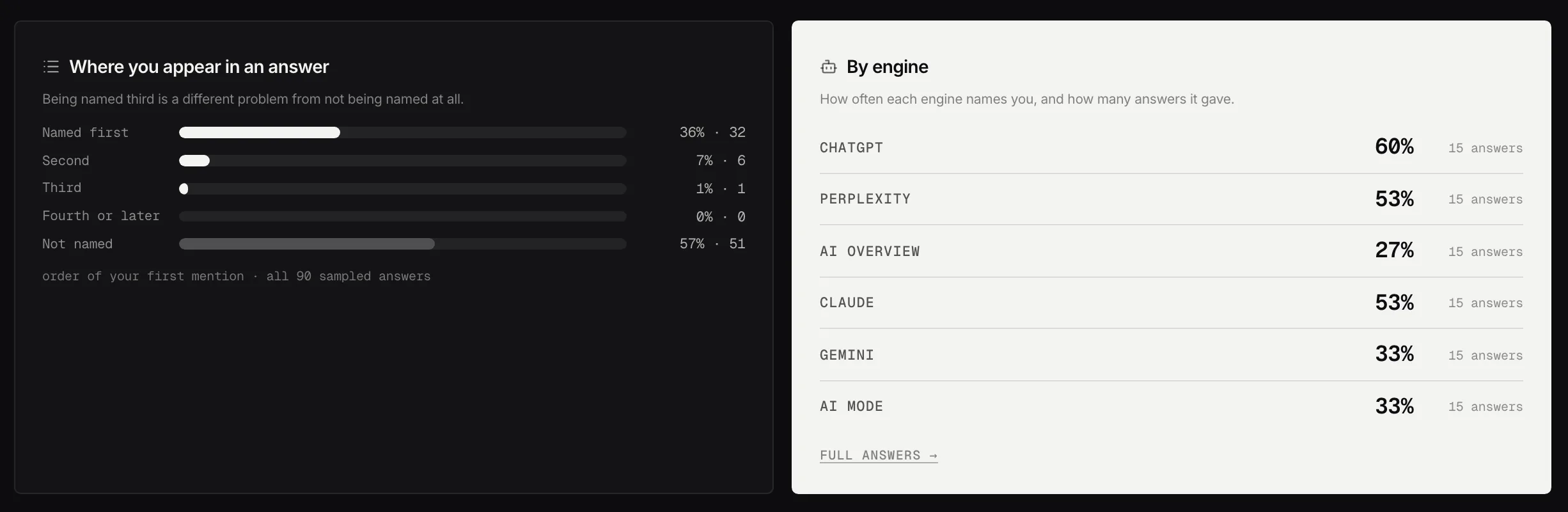
Where you appear in an answer, and how often each engine names you.
Demo data