Table of contents
There are two unhelpful extremes in the AI and SEO conversation.
One says the model can do the strategist’s job. The other treats AI as something serious search teams can safely ignore.
Neither matches how the work actually looks.
The co-pilot comparison is useful because it puts the split in the right place. Software can monitor, check and process far more information than a person can. The person still decides where to go and what to do when something changes.
Where software helps
A real search program has a lot to read. Search data, technical health, demand, competitors, changing SERPs, AI answers and the work already in flight.
Most teams don’t struggle because nobody knows what a canonical tag is. They struggle because the useful signal is buried across too much data, and reviewing all of it properly every week takes time that then isn’t available for the work itself.
Software is good at that first pass. It can keep reading the same sources, compare what changed and surface the handful of things that deserve attention.
Then the strategist takes over.
Context is still the job
A model can spot that a page is underperforming. It doesn’t automatically know that the page is being replaced next month, that legal won’t approve the suggested copy, or that the query attracts the wrong type of lead.
That context changes the recommendation.
It’s why we don’t think “AI strategy” means handing the account to a model. Synthesis is useful, but strategy is deciding what matters for this business, what to ignore and what to do next. Someone still has to own that decision.
The opposite approach has a problem too. Refusing the software means asking skilled people to spend more of their week assembling datasets, checking repeated patterns and rebuilding the same analysis. That’s not protecting the craft. It’s using expensive judgment for work a machine can do well.
What the loop looks like
In our own work, the software keeps reading the search picture and flags what changed. A strategist reviews the important moves, removes the false positives and adds the client context. Then we act, brief the work or deliberately leave it alone.
After that, the system keeps watching.
The value is not that AI makes the decision. It’s that the strategist gets to spend more time making decisions and less time building the spreadsheet needed to reach them.
That’s the model Searchscope is built around, and how Growth Minded Marketing works day to day.
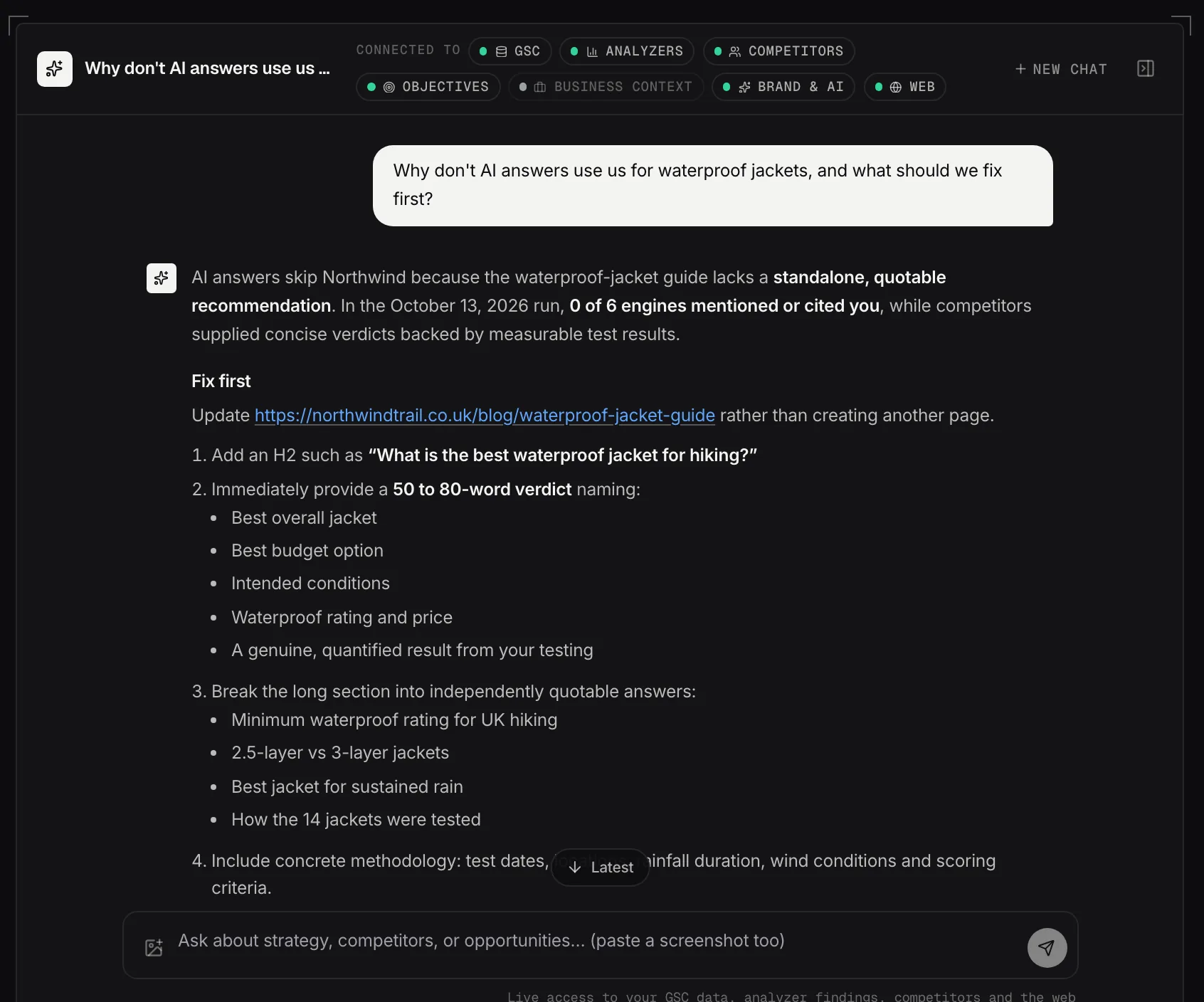
An answer built from the account's AI answers, the page record and the sources AI used instead.
Demo data